
Dot Inspection Checklist
A fleet safety and compliance checklist involves a DOT inspection checklist. All commercial motor vehicles should be able to comply with federal safety standards before they are allowed to be on the road. DOT inspections make sure that drivers and vehicles are operating under the safety regulations of the Department of Transportation.
A DOT inspection is an all-inclusive check-up of commercial motor vehicles (CMVs). It is performed by the Federal Motor Carrier Safety Administration (FMCSA). It is done to make sure that not only do vehicles, but drivers as well, comply with federal safety standards.
Table of Contents
Why Does the DOT Inspection Checklist Matter?
In a DOT inspection sheet, the officials consider a variety of aspects such as vehicle condition, operator documents, hours of service, and cargo securement. The inspection levels include simple driver inspection and an extensive assessment of the vehicle, which includes brakes, tires, and steering systems, to emergency equipment. This is aimed at ensuring all trucks and drivers on the road work within the boundaries of safety.
Legal compliance is not only the point of DOT Inspections, but it is also important to ensure operational integrity and the reputation of the business. Brake-related violations accounted for 41.1% of all vehicle out-of-service violations during the 2025 International Road check. This makes brakes the leading cause of vehicle out-of-service orders across North America. Non-compliance can lead to fines, out-of-service orders, or even loss of operating authority, significantly impacting a company’s reputation.
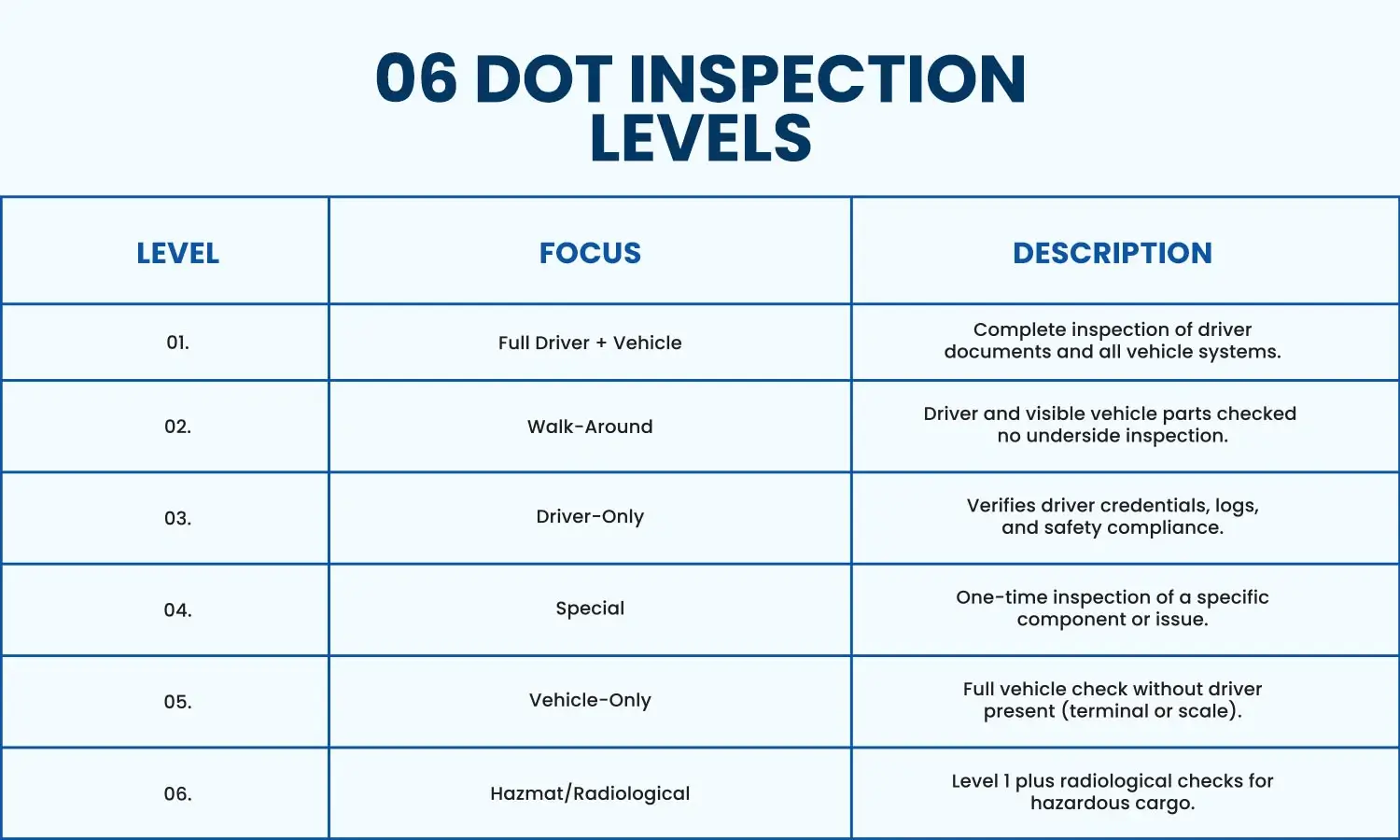
6 DOT Inspection Levels
These six include the general roadside inspections and the specifications of the driver or vehicle. Being ready for DOT bus inspection checklist of any degree will keep your fleet on track, lessen downtimes, and enhance the safety of the road.
Level 1:
Most comprehensive roadside examination: the examiner examines the driver (credentials, hours-of-service, medical card) and the vehicle (brakes, tires, lights, coupling devices, cargo securement, etc.). This DOT level 1 inspection checklist is the most frequent, and the one you should prepare for as if it’s coming every trip.
Level 2:
Less invasive vehicle inspection that does not require the opening of compartments and checking the underside; nevertheless, it assesses driver documentation and visible parts of a vehicle, often included in a DOT level 2 inspection checklist.
Level 3:
Driver-oriented: license, medical examiner certificate, hours-of-service records, seat belt, and administrative items – no mechanical inspection of the vehicle are part of DOT level 3 inspection checklist.
Level 4:
Targeted, one-time checks designed to examine a particular item or trend (for example, spot-checking a suspected issue across a carrier’s fleet).
Level 5:
Vehicle-only version of Level 1 (no driver present) often included in a DOT vehicle inspection checklist: used in yards, scales, or impound lots. Inspectors run through the vehicle inspection items from the NAS.
Level 6:
A Level 1 inspection plus radiological-specific checks for vehicles carrying radioactive materials; requires additional instrumentation and procedures.
Need help passing your next DOT pre-tip inspection checklist with confidence? Let CS Truck & Trailer’s experts get your fleet inspection-ready.
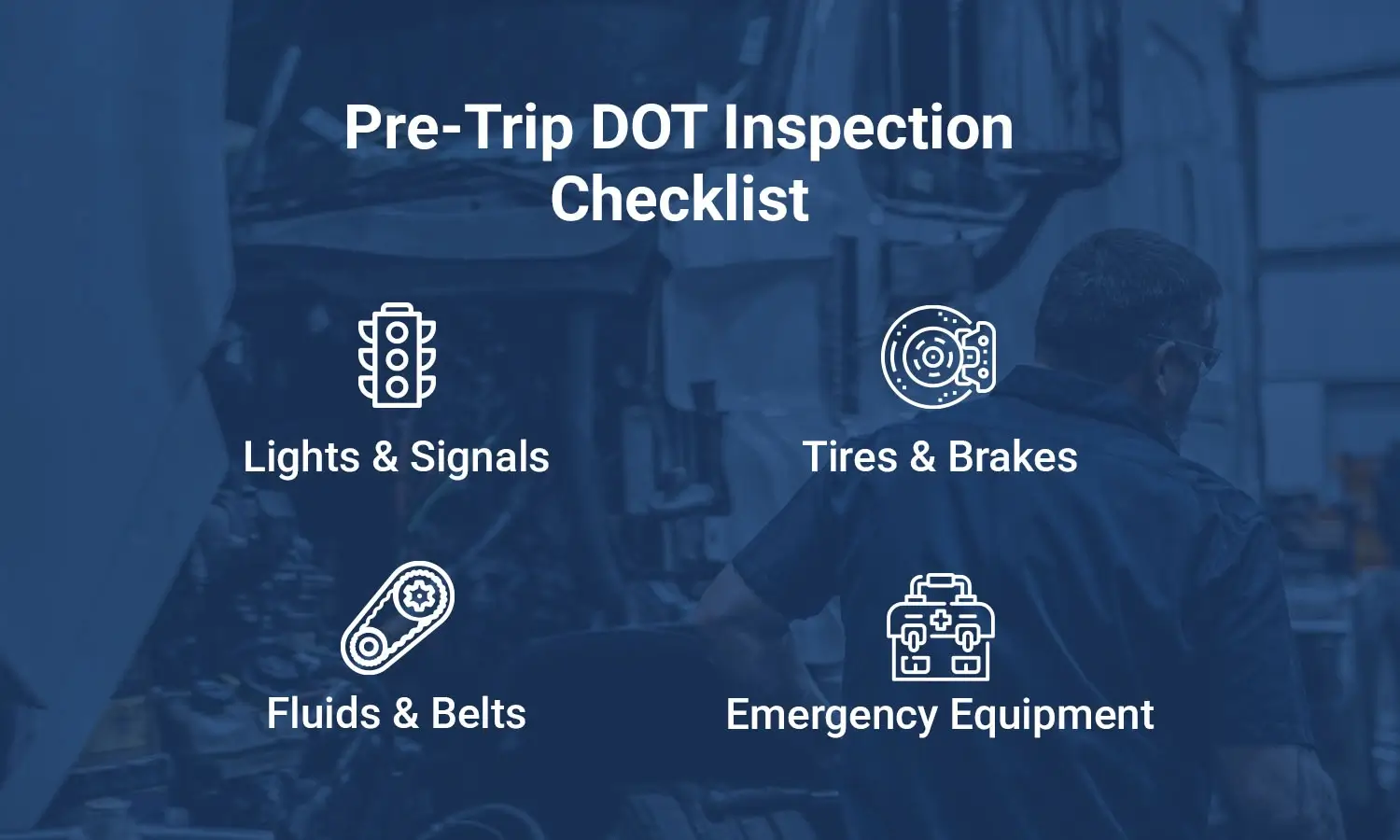
Pre-Trip DOT Inspection Checklist
A regular DOT pre trip inspection checklist helps drivers check the condition of their vehicles. It will help to know that the vehicle is roadworthy before taking off. Drivers can easily avoid any accidents, roadside breakdowns, and expensive violations. According to the FMCSA regulations (396.13), DOT pre-trip inspection requirements are the first line of defense against non-compliance by drivers.
Lights and Signals
Drivers should make sure that all the lights are operational. Headlights, tail lamps, brake lights, turn signals, clearance lights, and reflectors, all of it should be clean before they begin the journey. Check wiring for frays or corrosion, install new bulbs that are burned. And make sure to have reflectors that can be seen at the necessary distances as per FMVSS specifications. Functioning lights are vital on a DOT pre trip inspection form and a DOT pre trip inspection list because they enable visibility, prevent collisions, and are among the most basic, yet most crucial, aspects of a DOT safety inspection checklist.
Tires and brakes
Check all tires for proper inflation, checking tread, and checking them against cuts, swellings, or unusual wear. See tire pressure with a gauge. Try to confirm that it is within the specifications of the manufacturer. Check wheel rims for cracks or rust trails that could signal loose lug nuts. Inspect broken pieces on the brakes, check air pressure, and detect leaks in lines or chambers.
Fluids and belts
Check oil, coolant, transmission fluid, power steering, and windshield washer levels, topping off as necessary. Check hoses and belts to see whether they are cracked, frayed, glazed, or leaking. Proper belt tension ensures alternator and fan operation, while intact hoses prevent coolant and air leaks. Keeping correct fluid levels helps prevent violations on an annual DOT inspection checklist and improves vehicle performance and longevity.
Coupling devices
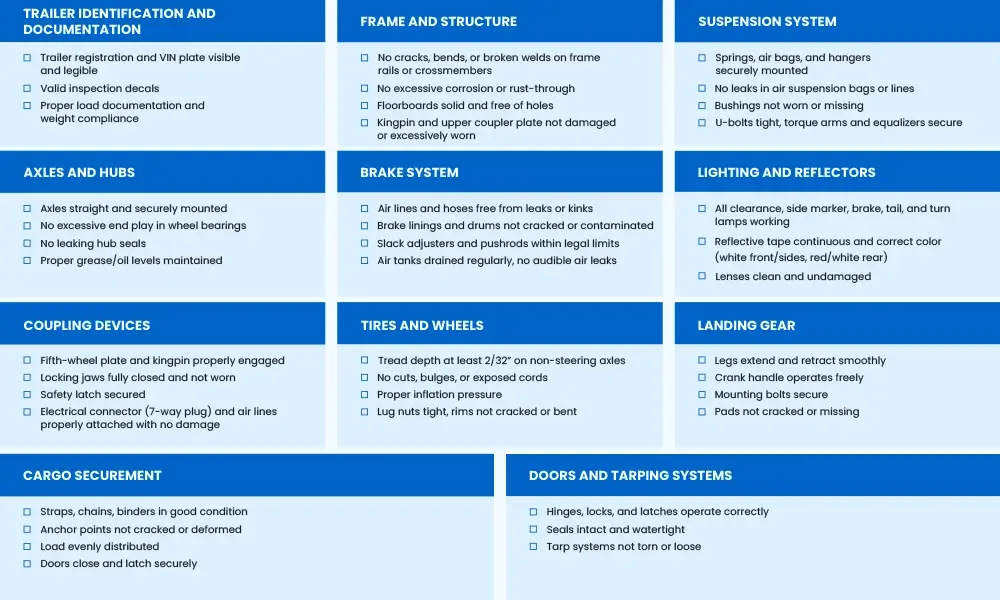
The fifth wheel should be inspected to ensure that it has no cracks, it is well locked and lubricated. Make sure the kingpin is not bent or worn, and ensure that the jaws are locked at the kingpin. Check that safety chains, glad hands, and electrical connectors are attached properly and in good condition. Ensure that the fifth wheel is properly seated and there is no gap between the trailer and the ground, and the release handle should be locked. Check air lines, inspect. A secure coupling prevents trailer separation and ensures compliance with a DOT trailer inspection checklist and a DOT commercial vehicle inspection checklist.
Emergency equipment
Emergency equipment checks are done before a trip, as they ensure that it is ready to work on the roadside or in hazardous conditions. The drivers should be provided with a charged and mounted fire extinguisher, three reflective triangles, and spare fuses or circuit-breakers. Check fire extinguisher labels, ensure that the gauge is charged, and ensure that the warning triangles have no broken or missing reflectors.
DOT Truck Inspection Checklist
A comprehensive DOT truck inspection list includes the credentials of the driver, truck systems, and safety equipment. Documents, critical mechanical, lighting, tires, and emergency gear should be checked before and after the trip. A consistent checklist assists drivers and fleets in identifying problems prior to them drawing violations or causing expensive breakdowns.
Steering and suspension
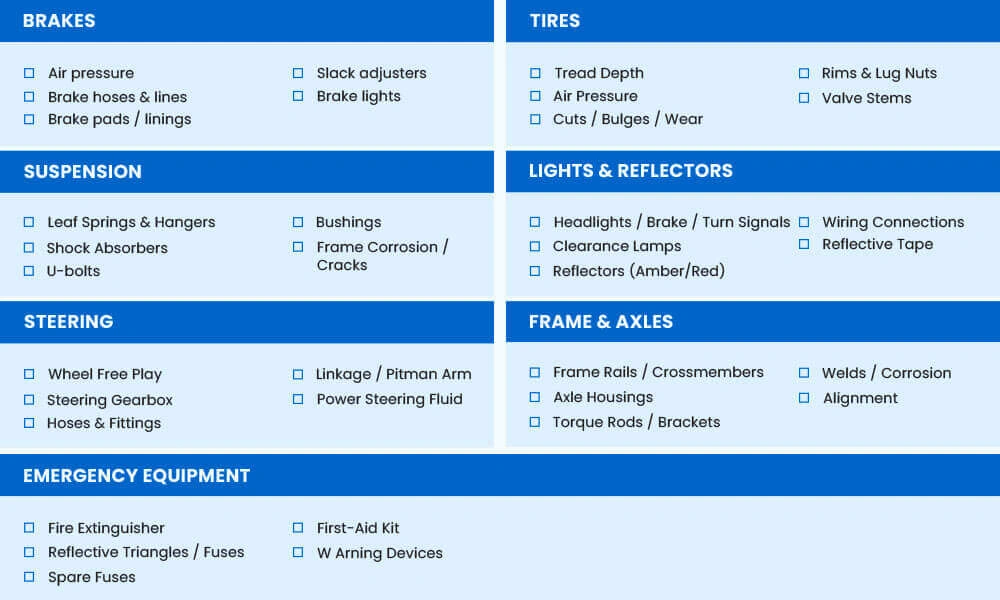
Suspension failures and steering failures are safety-critical. Inspectors will look at excessive play in the steering linkage, worn or cracked steering parts, damaged or missing bushings, torque rod and spring hangar integrity, and observable steering gear leakage. Suspension checks will involve spring condition (no loose leaves, too much corrosion), shock condition, and tight U-bolts. Lumpy axle ride or axle misalignment can be evidence of broken suspension parts or a broken frame. Fit grease to fittings on a regular basis, replace worn bushings in time, and include steering checks at each pre-trip inspection to prevent out-of-service (OOS) citation.
Frame and axles
The frame and axles of the car should be safe: there should be no cracks, serious corrosion, or broken welds, and also no athletes and no deformed/shifted metal. Check frame rails, cross members, spring seats, axle housings, etc., for deformation or fractures. Notice brackets and hangers of torque rods, where stress is concentrated; fatigue cracks frequently begin here. The misaligned axes may lead to the quick wearing of tires and steering issues; alignment verification should be used as part of the preventive maintenance. Including these items in your DOT vehicle inspection checklist ensures the truck’s structural integrity and reduces long-term maintenance costs.
Brake systems
Brake systems are among the top causes of DOT inspection violations. Inspectors check the integrity of the air system, ensuring there are no audible leaks, the governor cuts in and out properly, hardware is secure, brake linings are free of oil or grease, and slack adjusters operate correctly. For hydraulic or brake-by-wire systems, they verify that warning lights function and fluid levels are adequate. Air tanks should be drained regularly, CCV systems should operate properly, and automatic adjusters must be in good working condition.
Reflectors and lamps
A common subject of inspection is lighting and reflective equipment. Check all headlamps, tail lamps, turn signals, brake lights, clearance lights, marker lamps, and reflectors on their functionality, proper positioning, and condition. Make sure lenses are clean and free of cracks, and that bulbs or LED modules are of the specifications set by the manufacturer. Trailer reflective tape should be continuous and of the right color (FMVSS/CVSA) (white on the front/sides, red/white on the back). A working lighting system is essential to passing any DOT safety inspection checklist.
DOT Trailer Inspection Checklist
Making the Right Choice (Common DOT Violations to Avoid)
Common inspection failures will be both driver-documentation failures and mechanical failures. According to FMCSA and industry statistics, the following are the leading issues:
- Frequent inspection failures: include both driver-documentation issues and mechanical defects.
- Inoperable lamps / defective lighting devices: Routine pre-trip lamp checks catch most issues.
- Lack of proof of periodic inspection: Failing to carry or produce the periodic DOTÂ inspection report can result in violations. Maintain a digital and paper copy.
- Brake out of adjustment/brake component failures: the leading mechanical cause of OOS violations; keep a proactive brake program.
- Tire problems (tread depth, flat/air leaks): Â tire defects lead to immediate hazards and inspection stops. Rotate and replace tires on schedule.
- Driver paperwork issues: missing/expired CDL, medical card, or hours-of-service records, administrative failures frequently show up in national statistics.
- Missing or discharged fire extinguisher/emergency devices: easy to fix, but commonly cited.
How to remain compliant - useful tips:
- Normalize pre-trip and post-trip DVIRs: Ask drivers to fill in and present photos of essential items (lights, tires, fire extinguisher). Online DVIRs minimize the errors in paperwork.
- Introduce planned preventive maintenance (PM): Apply PM intervals according to the recommendations of manufacturers and actual measurements (miles, engine hours). PM programs reduce downtime and reduce the cost of long-term repairs.
- Keep proper and reachable records: Retain photocopies of inspection documentation, maintenance documents, and certifications- auditors and inspectors will usually demand evidence.
- Train drivers in documentation and general checks: An educated driver will not allow administrative and minor mechanical offenses to grow bigger. Regular auditing minimizes the results of audits.
Benefits of a Regular DOT Vehicle Inspection Checklist
A disciplined DOT vehicle checklist inspection is cost-effective and minimizes the risk, and improves fleet uptime. The frequent check of the trucks indicates small problems before they become a rollover, brake issues, or other roadway failures; they safeguard drivers and other road users and minimize the out-of-service orders that upset the schedule. Carriers that have good inspection and maintenance histories will have lower insurance rates, fewer financial penalties in audits, and improved CSA (Compliance, Safety, Accountability) scores, all of which safeguard the reputation and bottom line of a carrier.
1) Improved safety.
Periodical inspections of brakes, steering, tires, lights, and cargo fastening prevent accidents directly. Few on-road incidents are associated with fleet preventive maintenance programs due to the replacement of components based on a condition and not based on emergency failure.
2) Fewer downtimes and fewer repair bills.
Intended maintenance prevents emergency shops and tow bills. There are a few on-road accidents related to the fleet preventive maintenance programs since there is a replacement of the parts, not due to the risk of failure, but according to the condition of the parts.
3) Enhanced reputation, compliance, and monetary benefits.
Fewer records of roadside violations and clean inspection records reduce the chances of an audit escalating to fines. The FMCSA statistics of 2023 indicate that all kinds of audits had high audit violations; this is why it is significant to keep the records and perform maintenance proactively. A positive DOT inspection record is also seen by shippers and brokers as one that values safe and compliant carriers.
Your Partner in Compliance and Fleet Efficiency
CS Truck & Trailer offers preventive maintenance programs and DOT inspection preparation services to help fleets stay compliant, minimize violations, and improve uptime. Their solutions include:
- Customized PM schedules
- Driver training for pre-trip inspections and DVIRs
- Documentation assistance for DOT compliance audits
- On-site inspection readiness assessments
Frequently Asked Questions
A standard Level 1 DOT inspection checklist includes driver qualifications and vehicle mechanical inspection: driver license and medical card, logs of the hours-of-service, seat belt usage, and braking system, tires, wheels/rims, suspension, steering, coupling devices, lights/reflectors, emergency equipment, and cargo lock where necessary.
Checks before every shift or trip should be conducted by drivers as a DOT pre-trip inspection. In addition to that, set up regular checkups according to the recommendations of vehicle manufacturers and your PM schedule (e.g., change oil every 5000 miles, service brakes after 6000 miles). Best practice in the industry is regular DVIRS (daily) and scheduled PM (weekly/monthly depending on usage).
Level 1 is a complete driver + vehicle check (the entire NAS checklist). Level 3 is driver-only – it is more concerned with credentials, hours of service, medical cards, and administrative documents; it does not involve such in-depth inspections in terms of vehicle mechanical issues.
Yes. CS Truck & Trailer will offer driver training, preventive maintenance programs, and DOT inspection preparation to minimize violations. They offer their services, such as pre-trip checklists, DVIR implementation, documented PM plans, and on-site inspection prep, which are aimed at helping fleets to pass roadside checks and to score higher in terms of CSA.
Bottom Line
Being ready for any DOT inspection means doing regular checks, keeping accurate records, and maintaining a strong safety culture. A complete DOT inspection checklist, along with preventive maintenance and driver training, helps reduce violations, protect drivers, and build your fleet’s reputation. With support from services like CS Truck & Trailer, creating and following such a program becomes much easier and more reliable.
Recent Posts

Author

Margaret Johnson
Fleet Industry Copywriter – CSTT
Margaret Johnson is a professional content writer specializing in fleet management, vehicle maintenance, and repair industry insights. I create well-researched, practical, and SEO-driven content that helps fleet managers and business owners make informed decisions. With a focus on clarity and value, Margaret translates complex technical topics into easy-to-understand, actionable information.