




CDL Inspection Checklist: Complete Pre-Trip Inspection Guide
During a three-day inspection blitz conducted in the U.S. last week, more than 10,000 commercial vehicles were taken out of service. Most were due to brake, tire, and light-related defects that should have been identified prior to service. That is not a figure; it is a warning.
Every day, drivers face delays, citations, or even worse, all due to these neglected maintenance issues. A complete Commercial Driver’s License CDL inspection checklist is no option; it is your front-line defense against breakdowns, compliance failures, and downtime. The following is a guide on how this is done, detailing all the steps drivers and fleet owners should follow to remain compliant with DOT and FMCSA regulations.
Table of Contents
What is a CDL (Commercial Driver’s License) Inspection?
This is an elaborate checklist that you may refer to before starting your trip. It can make you aware that your vehicle is safe and is satisfying the law of the Department of Transportation (DOT) and the Federal Motor Carrier Safety Administration (FMCSA). After this inspection, you can hit the road with confidence and avoid those costly out-of-service orders. An in-depth check-up is not only a legal obligation but a promise of safety. Daily CDL pre-trip inspection is the surest way to know that your equipment is in the best possible condition.
Unlike regular vehicle checks, a CDL inspection checklist is more detailed and standardized. It covers specific vehicle components that can directly impact public safety. A typical personal vehicle inspection might focus on tire pressure and fluid levels. But a CDL inspection list dives deep into air brake systems, coupling devices, suspension, and emergency equipment. This helps Class A, B, and C vehicles meet strict safety criteria every time they operate.
CDL Truck Inspection Checklist
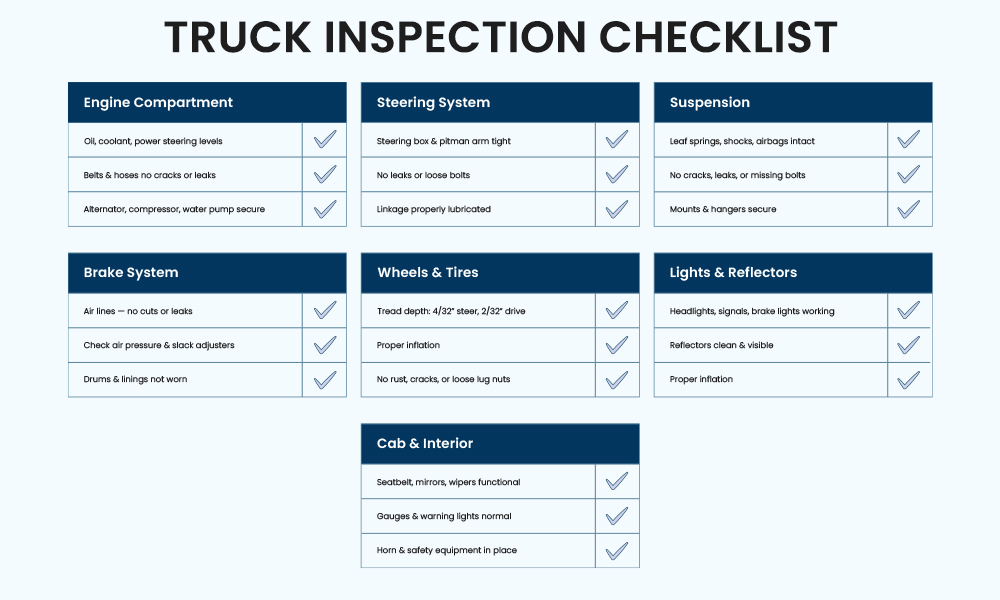
The CDL Truck Inspection Checklist is a stepwise procedure adopted by the driver to ensure that all the components of the vehicle are in safe working conditions before leaving. Even the least of the components may lead to fines, delays, or even a failed test during a DOT inspection or CDL exam. Adhering to this checklist will also assist fleets in avoiding unscheduled downtime in order to ensure a high Compliance, Safety, Accountability (CSA) score as well as pass roadside inspections without hassle.
Schedule your CDL Inspection Prep with CS Repair today. Save hours on paperwork and keep your trucks on the road where they belong.
Important areas a CDL driver should check before starting a route are listed below.
Exterior CDL Inspection List
The exterior examination of the CDL driving test checklist starts with the visual inspection of the car by walking around it.
- Check truck tilt for suspension issues.
- Inspect underside for any fluid leaks.
- Ensure lights, reflectors clean and visible.
- Check mirrors, windshield, doors for cracks.
- Confirm tread depth: 4/32 and 2/32.
- Measure tire pressure with air gauge.
- Look for rust streaks on lug nuts.
- Ensure mud flaps, plates securely fastened.
If you’re looking for affordable truck body repair and painting, Contact CS Repair.
Engine Compartment Pre-Trip CDL Checklist
- Check hood condition for leaks or damage.
- Open hood and inspect components thoroughly.
- Ensure all fluids between MIN and MAX.
- Verify proper fill of all reservoirs.
- Belts and hoses clean without ABC damage.
- Belt play should be half-inch maximum.
- Inspect alternator, compressor, water pump securely.
- Ensure no leaks or frayed cables.
- Steering gearbox and pitman arm lubricated tightly.
Proper inspection of these parts ensures the safety of the truck, as well as, avoidance of expensive repairs and better fleet management.
CDL Pre-Trip In-Cab Inspection List
Check the safety and functionality of all the interior systems inside the cab. Pre trip CDL checklist is incomplete without an in-cab inspection.
Seatbelt must clasp, slide smoothly without frays.
- Turn ignition to verify indicator light functions.
- Check ABS, air, oil indicator lights.
- Ensure mirrors, wipers, defrosters provide visibility.
- Oil pressure should read 25–50 psi.
- Air pressure optimal between 120–140 psi.
- Voltmeter must stay between 13–14 volts.
- Temperature gauge should remain in normal range.
- Test city horn and air horn operation.
- Confirm all interior and exterior lights working.
- Fire extinguisher must be fully charged.
- Three reflectors present with spare fuses.
Brake System CDL inspection List
The brake check is the most important safety measure. Inspect the air brake hoses for leaks, cuts, or audible air loss. There is a maximum of one inch of free play. It should never be exceeded. Make sure there is a 90-degree angle between the brake chamber and slack adjusters. The brake drums should be in the form of plain disks. Check for any cracks or heat discoloration. The linings are to be at least ¼-inch thick.
Conduct an air brake test with four parts as part of the SALE procedure:
- Static Test: Shouldn’t be more than 3 PSI loss in 60 seconds.
- Applied Pressure Test: No more than 4 PSI loss in 60 seconds under brake pressure.
- Low Air Warning: Buzzer/light activates around 55 PSI.
- Emergency Pop-Out: Valves release between 20–45 PSI.
Trailer CDL Inspection
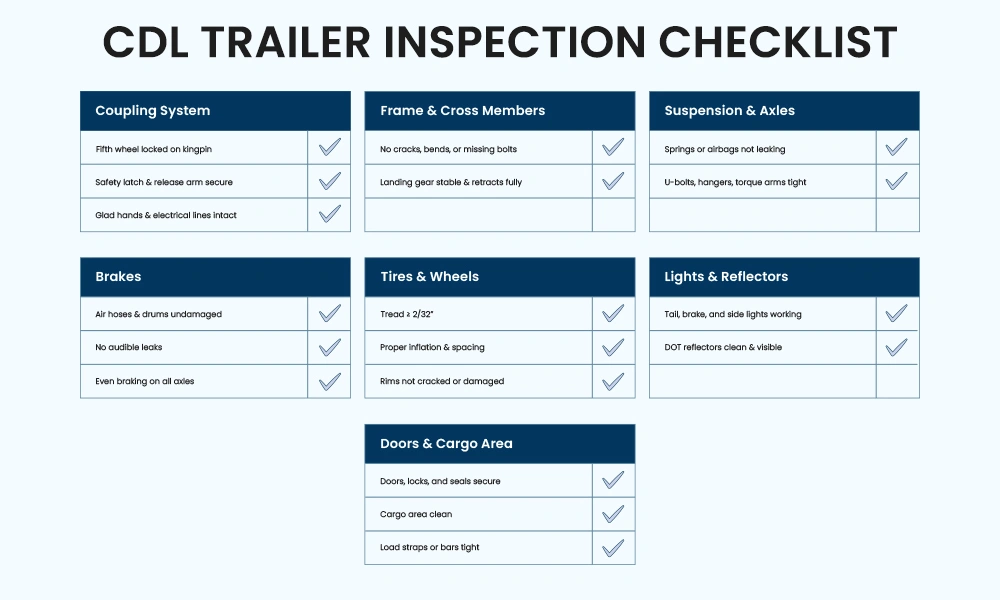
For combination vehicles, inspect the trailer as thoroughly as you check the tractor. Start at the point of coupling, with the glad hands sealed, the electric lines should be secured, and the fifth wheel locking jaws fully engage with the kingpin. The release arm and the safety latch are to be locked properly.
The frame of the trailer, the cross members, and the landing gear must be checked whether there are any cracks or bends, or they are any missing bolts. The suspension should bear airbags or leaf springs that are not leaking. Ensure that the rear doors are well latched and reflectors are neat. All the axles, tires, and brakes must be examined to be in even condition and have non-hazardous treads. The whole trailer should be inspected in order to avoid detachment or loss of control.
Differences between Classes of CDL and Before Trip Inspection.
The commercial driver license is divided into three major categories A, B and C. Each of them have inspection requirements.
CDL Class a Pre-Trip Inspection Checklist
- Covers tractor-trailers or combination vehicles that have a GCWR of greater than 26,001 lbs and towing capacity exceeds 10,000 lbs.
- The areas of focus are coupling devices, trailer brakes, fifth wheel, suspension, and air lines.
- The systems of the tractor and those of the trailer should be inspected by the drivers during the CDL Class A pre-trip inspection.
- A CDL A pre trip inspection list or CDL pre trip inspection cheat sheet should be used to be reminded of all the connections points and brake checks when taking the CDL driving test checklist.
Class B CDL Pre-Trip Inspection Checklist.
- Applies to those vehicles over 26,001 lbs that are single such as box trucks or buses.
- Emphasis is made on air brakes, mirrors, lights, tires and passenger safety equipment.
- In Class B checks there are no checks on couplings but focus on interior safety and accessibility.
Class C CDL Pre-Trip Inspection Checklist.
- Covers less commercial vehicles that transport hazardous materials or 16+.passengers
- The areas of concern are the seat belts, mirrors, emergency exits and warning devices.
- Guarantees complete safety of passengers and cargo.
Requirements for Class A CDL Pre-Trip
- Applies to both tractor-trailer combinations.
- Includes all standard vehicle inspection points, plus:
- Coupling devices
- Trailer brakes
- Suspension systems
- Longer and more detailed than other CDL classes due to extra trailer components.
- During the CDL test, examiners check that drivers:
- Confidently and clearly explain each part they inspect.
- Can identify defects and describe what they’re checking for.
- Show safe habits, such as using three points of contact when entering or exiting the cab.
- Know how to test air brakes.
- Check tire spacing on dual tires.
- Make sure that the fifth wheel has been greased and locked before the road test.
Some of the most frequent errors made by drivers during the CDL inspection
- Rushing on the CDL inspection checklist without inspecting the parts properly.
- Skipping steps or depending on memory instead of using a written or digital checklist.
- Missing small defects, such as:
- Low fluid levels
- Loose lug nuts
- Damaged glad hands (air hose connectors)
- Incorrect air brake testing or skipping parts of the procedure.
- Failing to explain aloud what they’re inspecting during the CDL test can cause automatic failure, even if the truck is fine.
- Not using inspection tools or systems to verify checks.
- Using digital DVIR systems (like those from compliance providers such as CS Repair) helps fleets track and confirm daily inspections accurately.
Frequently Asked Questions
A CDL pre trip checklist is a complete guideline of all the parts of the vehicles. It means all the parts should be inspected by commercial drivers by the time they start their journey. It also makes sure that the trucks comply with the FMCSA and DOT safety standards on the road.
The drivers should make a CDL pre-trip inspection their daily habit. It keeps everyone safe if done prior to the use of a commercial vehicle. This inspection is also to be registered in a Driver’s Vehicle Inspection Report (DVIR).
The inspection focuses on the tractor and trailer systems. It includes brakes, coupling devices, suspension, tires, and lights. These areas cover all the major safety points that need to be checked.
Although examiners will not permit the use of a physical checklist during test, practicing with free CDL pre trip inspection checklist will help you in recalling the procedure as well as what to pay attention to during the test.
Absolutely, CS Repair offers complete CDL inspection compliance packages, such as digital DVIR setup, fleet maintenance tracking, and pre-inspection training for drivers and managers.
Recent Posts
Author

Megan McTaggart
Fleet Industry Copywriter
Megan McTaggart is a professional content writer specializing in fleet management, vehicle maintenance, and repair industry insights. I create well-researched, practical, and SEO-driven content that helps fleet managers and business owners make informed decisions. With a focus on clarity and value, Megan translates complex technical topics into easy-to-understand, actionable information.